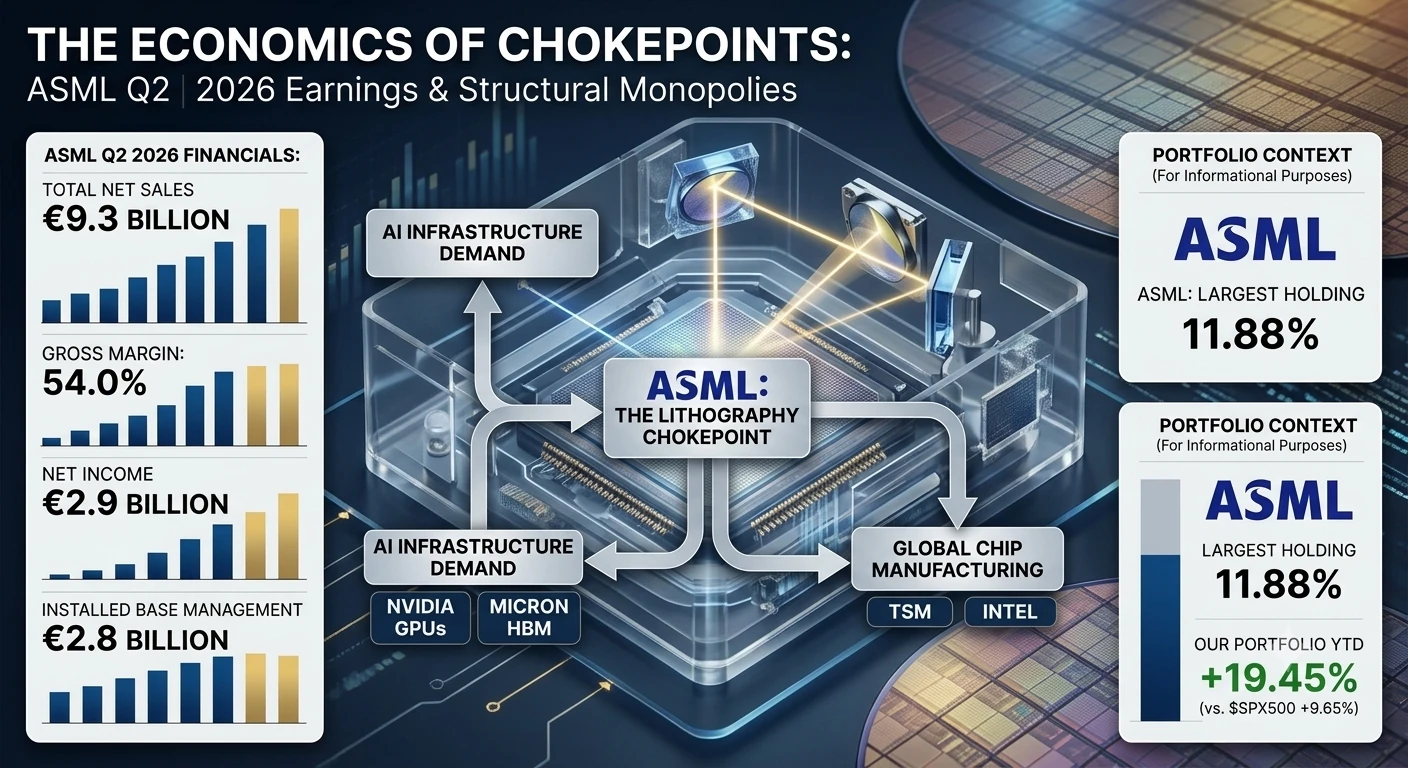
📊 𝗧𝗵𝗲 𝗘𝗰𝗼𝗻𝗼𝗺𝗶𝗰𝘀 𝗼𝗳 𝗖𝗵𝗼𝗸𝗲𝗽𝗼𝗶𝗻𝘁𝘀: 𝗔𝗦𝗠𝗟 𝗤𝟮 𝟮𝟬𝟮𝟲 𝗘𝗮𝗿𝗻𝗶𝗻𝗴𝘀 & 𝗦𝘁𝗿𝘂𝗰𝘁𝘂𝗿𝗮𝗹 𝗠𝗼𝗻𝗼𝗽𝗼𝗹𝗶𝗲𝘀
ASML's Q2 2026 financial results confirm our core thesis: the physical monopolies supplying the semiconductor industry command absolute pricing power, absorbing the capital expenditure of the global infrastructure build-out.
𝟭. 𝗧𝗵𝗲 𝗤𝟮 𝟮𝟬𝟮𝟲 𝗗𝗮𝘁𝗮
The numbers released today demonstrate strict execution and structural demand.
• Total Net Sales: €9.3 billion (beating guidance).
• Gross Margin: 54.0%.
• Net Income: €2.9 billion.
The most telling metric is the €2.8 billion generated from Installed Base Management, exceeding expectations by €300 million. Chipmakers are urgently upgrading existing field systems to extract immediate productivity gains. They cannot wait for new factories to come online; they need capacity today.
𝟮. 𝗙𝗼𝗿𝘄𝗮𝗿𝗱 𝗩𝗶𝘀𝗶𝗯𝗶𝗹𝗶𝘁𝘆 & 𝗘𝘅𝗽𝗮𝗻𝘀𝗶𝗼𝗻
Management increased full-year 2026 revenue guidance to €43–€45 billion and raised Q3 sales estimates to €11–€12 billion. ASML is formally adding 30% capacity to its low-NA EUV and DUV immersion lines for 2027, with investigations to add another 30% by 2028. This level of capacity expansion requires hard, long-term financial commitments from customers. It proves that the massive capital expenditures from cloud providers are translating directly into long-term order books for lithography equipment.
𝟯. 𝗣𝗼𝗿𝘁𝗳𝗼𝗹𝗶𝗼 𝗔𝗹𝗶𝗴𝗻𝗺𝗲𝗻𝘁
You cannot manufacture an advanced logic or memory chip without $ASML (ASML Holding NV). It is the definitive chokepoint of the digital economy.
This mathematical certainty is why ASML is the largest holding in my portfolio, representing 11.88% of our total value with a +13.78% P/L.
We do not speculate on software winners. We own the supply chain bottlenecks. The AI processor architectures designed by $NVDA (NVIDIA Corporation) and the high-bandwidth memory produced by $MU (Micron Technology, Inc.) rely entirely on ASML's lithography systems.
By concentrating capital in these foundational monopolies, we successfully decouple from broad indices. The data from the recent tech rotation confirms this structural resilience:
• $SPX500 (S&P 500) YTD: +𝟵.𝟲𝟱%
• $NSDQ100 (Nasdaq 100) YTD: +𝟭𝟱.𝟴𝟵%
• 𝗢𝘂𝗿 𝗣𝗼𝗿𝘁𝗳𝗼𝗹𝗶𝗼 𝗬𝗧𝗗: +𝟭𝟵.𝟰𝟱%
We hold the line. The digital industrial revolution requires physical infrastructure, and we own it. I invite you to review my open positions and historical data directly on my profile.
#ASML #Earnings #MacroStrategy #Semiconductors #StructuralMonopolies