 Executive Summary

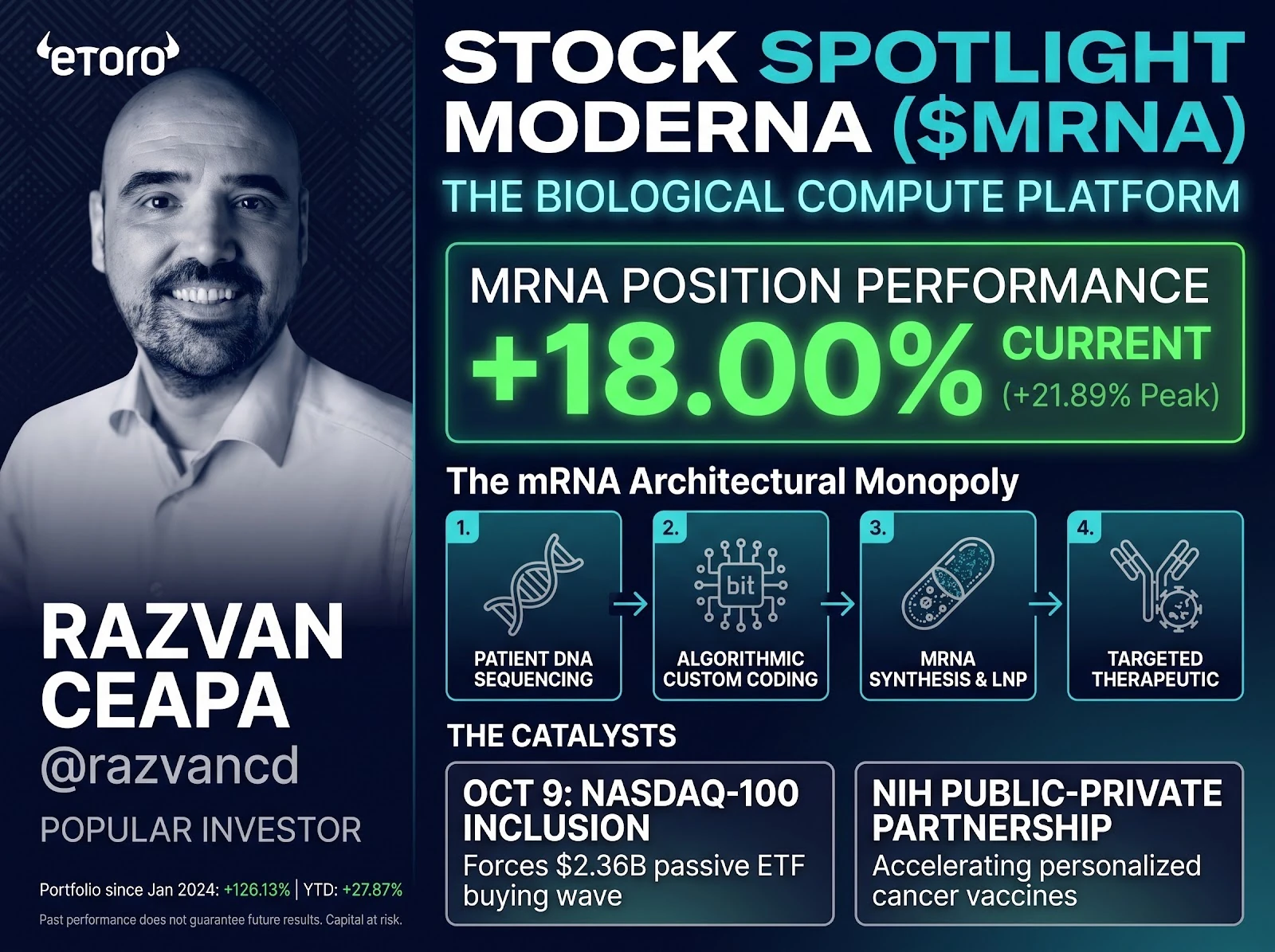
True compounding requires identifying structural bottlenecks where platform architecture replaces recurring operational costs. Applying our "Economics of Chokepoints" framework to biotechnology, our portfolio generated a +27.87% return YTD and +126.13% since January 2024, significantly outpacing the broad market.
Entering October 2026, we initiated a capital allocation in Moderna (MRNA). The position expanded by +21% within sessions of execution and currently holds an +18% unrealized gain. Moderna isn't a speculative biotechnology equity; it's an information technology platform applied directly to biological systems.
The Economic Model: Wet-Lab Craftsmanship vs. Software Compilation
Conventional equity research models evaluate pharmaceutical companies through isolated clinical trial probabilities. This view misses the structural microeconomics separating traditional small-molecule chemistry from messenger RNA platforms.
Legacy pharmaceutical discovery behaves like pre-industrial craftsmanship:
High Marginal Discovery Costs: Research organizations screen massive compound libraries in wet laboratories, attempting to identify physical binding affinity against pathological targets.
Bespoke Tooling: Every approved compound requires unique chemical synthesis methods, custom factory hardware, and distinct formulation supply chains.
Non-Compounding Operational Scale: Developing the next drug doesn't lower the manufacturing setup cost learned from the previous one.
Moderna reverses this economic paradigm by separating biological software from physical hardware:
The Hardware Chassis (Lipid Nanoparticles): Messenger RNA can't survive unassisted in the bloodstream. Moderna’s lipid nanoparticle delivery system acts as the standardized vehicle that transports genetic code across cell membranes.
The Software Layer (Digital Nucleotide Sequences): The therapeutic agent is pure digital instruction: an engineered sequence of four nucleotide bases (adenine, uracil, cytosine, guanine) instructing host cellular ribosomes to synthesize specific antigenic proteins.
Unified Infrastructure: Synthesizing an authorized respiratory shot or an individualized oncology therapeutic uses identical enzymes, identical bioreactors, and identical nanoparticle formulations. Only the digital sequence input changes.
This shift turns drug development from an empirical chemistry lottery into an algorithmic data-compilation chokepoint.
The Dual Catalysts of October 9, 2026
Our capital allocation was executed ahead of two converging institutional drivers that materialized on October 9:
1. The Nasdaq-100 Mechanical Inflow Wave
Moderna officially replaced Warner Bros. Discovery in the Nasdaq-100 index prior to market open on Friday, October 9.
Passive index-tracking funds manage assets by mandate, requiring immediate portfolio alignment regardless of market sentiment. On October 9, passive exchange-traded funds registered $2.36 billion in net buying across Moderna equity. The Invesco QQQ Trust absorbed $1.87 billion (8.33 million shares), with the Invesco NASDAQ 100 ETF (QQQM) deploying an additional $416.7 million. Positioning prior to this index event allowed our portfolio to capture passive institutional liquidity directly.
2. The NIH Public-Private Partnership
Simultaneously, leadership from the National Cancer Institute and the Foundation for the NIH confirmed a public-private partnership scheduled for formal launch in December 2026.
Designed around the accelerated regulatory frameworks applied during the 2020 pandemic response, this federal initiative directly targets difficult oncology indications—including pancreatic ductal adenocarcinoma, colorectal tumors, and pediatric cancers. Federal underwriting lowers clinical trial overhead while smoothing regulatory approval paths.
Clinical Proof Points: The INTerpath-001 Milestone
The federal push builds upon validated Phase 3 clinical execution. In late August, Moderna and Merck (MRK) announced that their Phase 3 INTerpath-001 study evaluating intismeran autogene (mRNA-4157) in combination with pembrolizumab (Keytruda) met its primary endpoint of Recurrence-Free Survival (RFS) and secondary endpoint of Distant Metastasis-Free Survival (DMFS) in resected Stage IIB–IV melanoma.
The clinical process confirms the algorithmic nature of the platform:
High-throughput sequencing of a patient's resected tumor identifies mutational signatures.
Machine-learning models isolate up to 34 patient-specific neoantigens exhibiting optimal immune presentation.
A single customized mRNA molecule encoding these targets is synthesized, formulated, and administered within weeks.
Detailed late-breaking survival data will be presented at the ESMO Congress on October 24, 2026, serving as the next near-term clinical validation point ahead of third-quarter financial results on November 6.
Valuation Realities and Asymmetric Risk Management
Analytical discipline requires weighing structural upside against balance-sheet risks:
Valuation Multiples: Following its 2026 appreciation, Moderna trades near 31x to 37x sales.
Earnings Realities: Trailing operating margins sit at -141.4%, with legacy respiratory franchise revenues falling 27.3% year-over-year to $2.23 billion as commercial oncology pipelines ramp up.
Execution Hurdles: Individualized oncology therapies require specialized needle-to-needle manufacturing logistics, presenting scaling challenges absent in mass-market pharmaceuticals.
We insulate total capital against binary biotech volatility through portfolio construction. Our foundational allocations remain anchored in cash-generative semiconductor monopolies and infrastructure bottlenecks (ASML, NVIDIA, TSMC). Allocating a controlled slice of capital to programmable biology captures platform repricing while insulating the broader portfolio from standalone clinical trial shocks.
How to mirror this portfolio:
Step 1: Search for razvancd on eToro.
Step 2: Click Copy and check "Copy Open Trades".
Step 3: Recommend a $500 minimum allocation.
Copy Trading is not investment advice | Capital at risk | Past performance does not guarantee future results.