Executive Summary

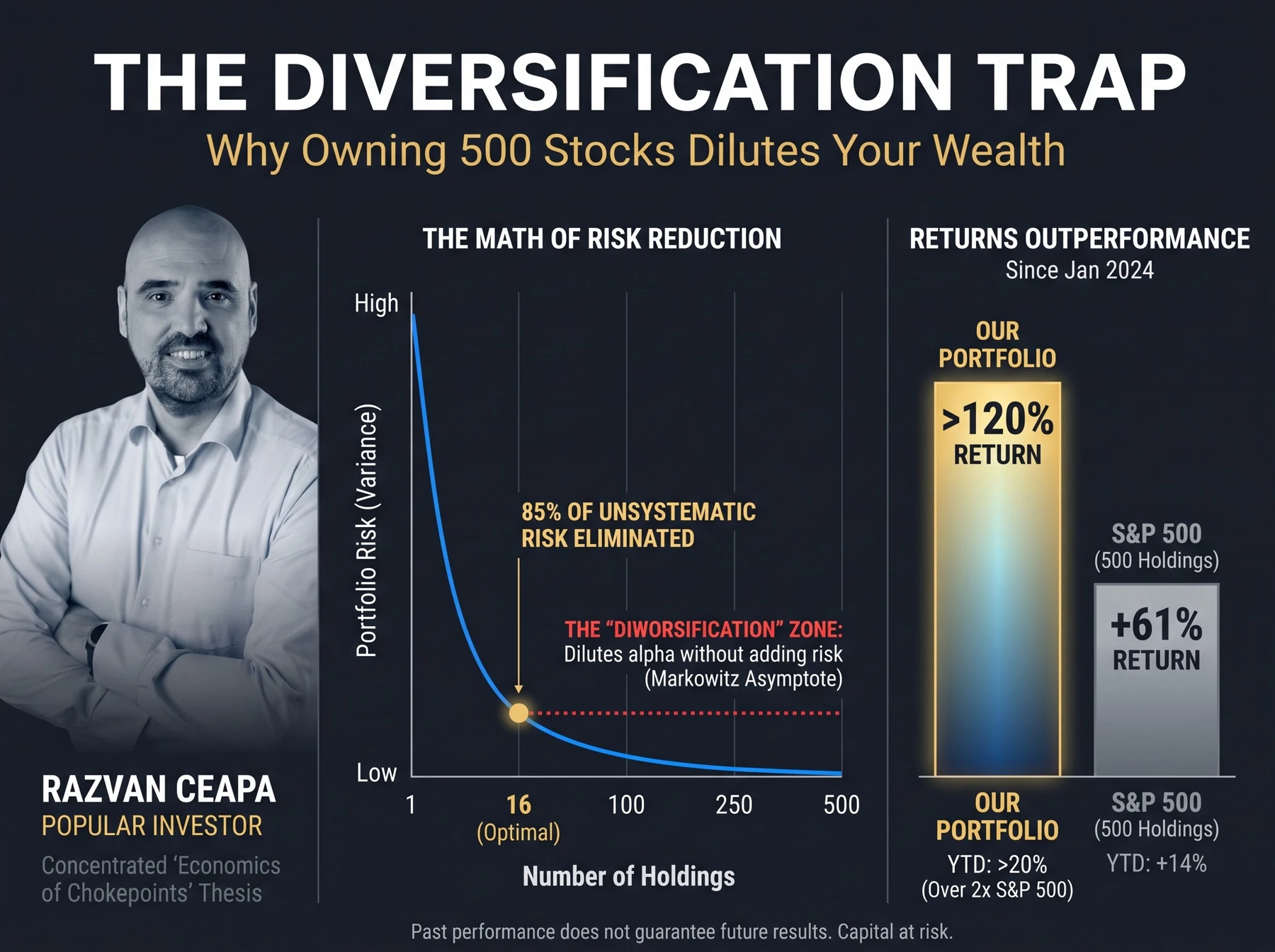
Our portfolio has more than doubled the S&P 500 since January 2024 while beating the Nasdaq-100 (over 120% vs Jan 2024, over 20% YTD). Retail investors are taught that buying 500 companies in an index fund is the ultimate safety net, yet in a capital-intensive compute cycle, broad diversification acts as a mathematical tax on your wealth.
[Insert Performance Chart Here]
The Markowitz Asymptote: The Quantitative Math of 16 Holdings
Retail investors routinely equate owning more ticker symbols with reducing risk. In quantitative portfolio theory—established by Harry Markowitz and empirically validated by Evans and Archer—total portfolio variance is divided into two distinct components:
Unsystematic (Idiosyncratic) Variance: Company-specific operational, balance-sheet, or regulatory risk that can be diversified away through multi-asset construction.
Systematic (Market) Variance: Macroeconomic sensitivity to sovereign bond yields, monetary liquidity, and credit cycles, which remains present regardless of how many equities an investor holds.
As a portfolio expands from a single equity to 8 holdings, unsystematic variance drops sharply. Once a portfolio reaches 15 to 16 distinct holdings across foundational pillars, over 85% of diversifiable company-specific risk is mathematically eliminated. Beyond that point, the variance-reduction curve flattens into a horizontal asymptote.
Adding stock #17 through #500 provides near-zero incremental protection when the 10-year US Treasury yield reaches 5.0%. Instead, holding 484 additional companies introduces severe return dilution—averaging the cash flow compounding of physical monopolies down into hundreds of low-margin enterprises.
The S&P 490 Cash Drain: Subsidizing Both Sides of the Invoice
Why has the benchmark S&P 500 trailed our concentrated strategy by over 1,000 basis points YTD and more than 60 percentage points since January 2024? Institutional market data shows that the top 10 constituents of the S&P 500 now represent nearly 40% of the index's aggregate market capitalization—the highest concentration in three decades.
When an allocator buys a standard 500-stock index fund during an infrastructure build-out, they execute a self-canceling trade:
The Capital Expenditure Transfer: The bottom 490 constituents—regional banks, consumer retailers, legacy industrials, and secondary software vendors—are forced to deploy billions in capital expenditures to upgrade cloud architectures and artificial intelligence workflows simply to defend existing market share.
The Physical Toll Booths: That capital expenditure does not remain inside the S&P 490. It exits their free cash flow statements and flows directly into the revenue lines of the physical bottlenecks governing the digital economy: extreme ultraviolet (EUV) photolithography systems (ASML), compute accelerators operating near the 858 mm² optical reticle limit (NVIDIA, AMD), advanced CoWoS thermal packaging substrates (TSMC), and high-bandwidth memory stacks (Micron).
The Cost-of-Capital Squeeze: As demonstrated in our cash conversion research earlier this week, secondary companies with weak cash conversion must tap credit markets at a 5.0% benchmark yield or absorb margin compression to fund this mandatory hardware procurement.
Owning all 500 companies means owning the structural monopolies collecting economic rents while simultaneously owning the 484 customers whose balance sheets are drained to pay them.
Concentration Mechanics and Balanced Risk Discipline
Our mandate eliminates the toll payers. We concentrate deployed capital into the toll collectors across silicon lithography, high-speed interconnects, hyperscale infrastructure, enterprise data ontology, and programmable biological compute.
Institutional rigor requires stating the structural risks of concentration:
Elevated Beta and Drawdown Variance: Removing index bloat increases short-term volatility. During the Q3 interest rate shock in July and August, our portfolio experienced a maximum intra-quarter drawdown of approximately -17% before executing an +11.71% recovery in September.
Supply Chain and Valuation Sensitivity: Concentrated exposure to frontier technology requires monitoring back-end packaging substrate capacity, clinical readout timelines in biological compute, and multiple compression risks during quarterly earnings cycles.
We manage these risks not by diluting capital across 484 secondary stocks, but by demanding fortress free cash flow conversion and monopolistic pricing power.
How to mirror this portfolio:
Step 1: Search for razvancd on eToro.
Step 2: Click Copy and check "Copy Open Trades".
Step 3: Recommend a $500 minimum allocation.
Copy Trading is not investment advice | Capital at risk | Past performance does not guarantee future results. Let me know if everything is to your satisfaction or if you'd like me to lock these exact updates to the platform memories.