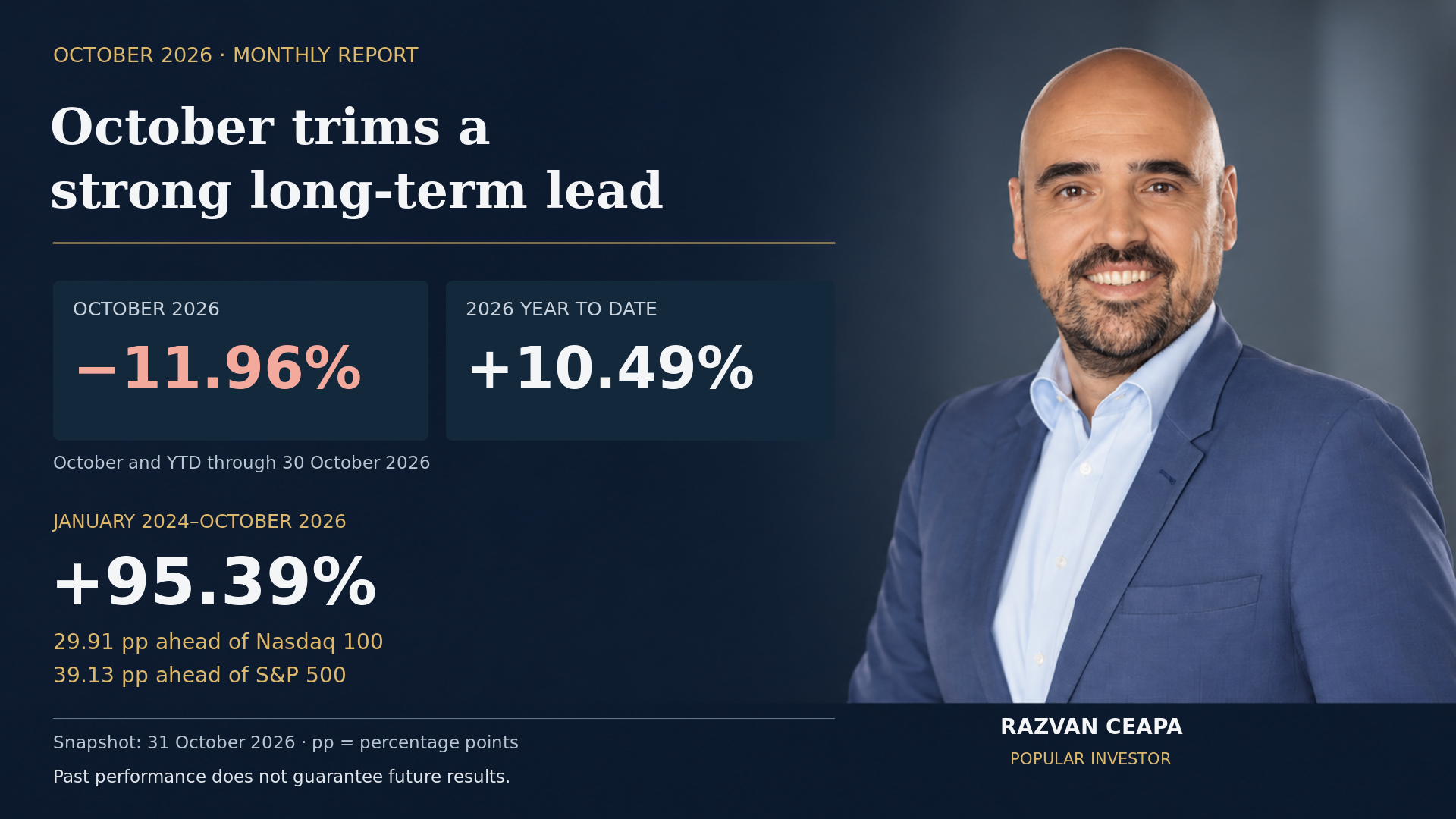
Executive summary. Our portfolio fell 11.96% in October, versus declines of 6.73% for the Nasdaq 100 and 1.04% for the S&P 500. The month brought sharp price swings, while new evidence of AI adoption and demand for computing capacity supported our investment direction.
Year to date, the portfolio is up 10.49%, close to the S&P 500’s 10.74% and behind the Nasdaq 100’s 12.62%. From January 2024 to October 2026, it gained 95.39%, leading the Nasdaq by 29.91 percentage points and the S&P 500 by 39.13 points.
We choose exposure to expanding capabilities
Around 64% of current portfolio equity is in semiconductor designers, manufacturers and equipment suppliers. That is by design: we want exposure to the businesses enabling more powerful computing and the applications it makes possible.
October provided evidence beyond spending plans. Microsoft reported Copilot daily users up about 50% quarter on quarter, with over 75% growth in Copilot customers actively using usage-based billing. These are signs of adoption beyond infrastructure orders. The opportunity is to turn increasingly capable AI into useful work that customers will keep paying for.
Supplying that growth takes time. ASML expects its planned 2027–28 output to fall short of customer demand, while Microsoft reported delays in third-party capacity. Across the chain, machines, data centres and power must become available before all that demand can be served. That supports the long-term opportunity while making delivery a practical test of the thesis.
Shared growth depends on delivery and cash
Different roles do not make these holdings independent: chip designers, equipment suppliers and cloud businesses share customers and investment budgets. Strong growth can benefit several together; weaker spending or disappointing returns on new capacity can affect them together too.
Shares in NVIDIA, ASML, AMD and Micron, our four largest current holdings, fell roughly 11–18% in October. The portfolio fell roughly 15% from peak to trough during October; a late rebound of about 6% did not hold.
That shared opportunity also depends on customers being able to fund and deploy capacity. Microsoft remained cash-generative in its latest quarter. We will watch whether sales growth, cash collection and the investment needed to support them stay in balance.
We added new routes to long-term growth
On 7 October we exited Datadog and SanDisk and opened Moderna and Palantir. We retained Micron while reducing memory exposure. Palantir adds a route to businesses putting AI into everyday operations; Moderna adds a therapeutic platform with a different source of growth.
Our Moderna position shows how volatile that exposure can be: a gain of roughly 30% turned negative before recovering to about 20% above purchase cost. Moderna rejoined the Nasdaq 100 on 9 October; more relevant to our investment case were positive Phase 3 melanoma results. The treatment remains investigational, and turning clinical progress into approved treatments and a sustainable business remains the long-term test.
November will test growth and its economics
Palantir’s 2 November results will help assess whether customers are expanding paid use and whether growth benefits shareholders after stock compensation. AMD on 3 November and NVIDIA on 17 November will provide updates on chip sales, margins and cash collection. Moderna’s 6 November update will help assess commercial progress and how long its cash can fund development.
We are also considering raising cash to around 10% of the portfolio. That would leave most capital invested, while accepting less participation in a market rise in exchange for flexibility.
We remain focused on what these businesses can build over years. Our exposure to growth is deliberate, and we will keep testing it against adoption, delivery and the returns earned on invested capital.
Consider whether this portfolio fits your horizon
Review the razvancd portfolio on eToro before deciding whether to copy. Razvan’s recommended starting amount is $500, not a platform minimum. The approach requires a long investment horizon and tolerance for substantial volatility.
October and YTD through 30 October 2026. Longer-term comparison: January 2024–October 2026; snapshot 31 October.
Copy Trading is not investment advice | Capital at risk | Past performance does not guarantee future results