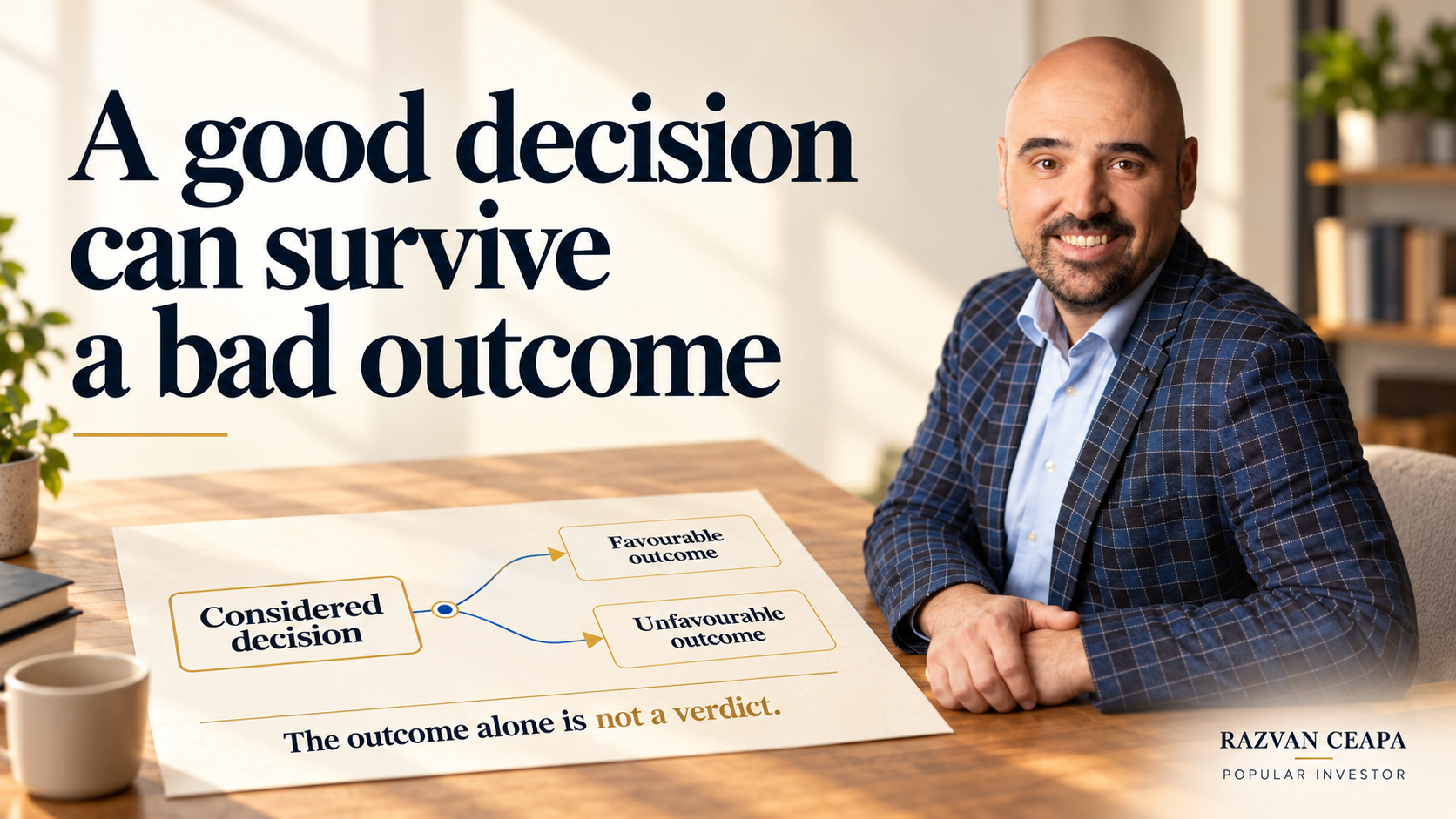
We learn more when we judge a decision fairly
A disappointing result does not, on its own, establish that a decision was foolish. A profitable result does not establish that it was sound. We need to consider what was reasonably knowable when the choice was made, while remaining willing to recognise mistakes. That distinction allows us to learn from an outcome without treating it as a verdict on our intelligence.
Imagine a friend accepts a new job. The work is interesting, the people seem good and the move makes sense for their family. Six months later, the company loses a major customer and the role disappears.
Was accepting it a mistake?
We would probably want to know more before answering. Were there warning signs? Or did a possibility our friend understood simply turn into an unfortunate reality?
With our own money, it can be harder to allow the same distinction. A loss feels like a verdict. A gain feels like confirmation. Neither gives us the whole story.
Choosing a future means accepting that it may unfold differently
Consider the decisions inside the companies we own. A team at Microsoft might back a software idea that customers never adopt. A manager at Amazon might reject a project that later proves successful in someone else's hands.
Neither ending, by itself, tells us whether the people involved were careless or thoughtful. We would need to understand the choices they faced.
A new chip design at NVIDIA or a research project at Alphabet can take years to reveal its value. The people backing it still have to decide before they can know the ending.
As shareholders, we live with that uncertainty too.
The result matters, but it does not tell the whole story
Our Moderna investment this October has made that distinction quite tangible. The gain moved to around 20%, then around 30%, turned negative and recovered. By Thursday, 29 October, the open position was again close to 20% above its entry cost.
That changing number can invite a different judgement of the same original decision every few days.
Our interest is long term. The recovery is welcome, but it does not establish that the investment will succeed. Equally, the period below the entry price could not, on its own, establish that buying had been foolish.
This is not an argument for ignoring losses. Money lost is real, and a decision can be poorly judged even when it was made sincerely. Understanding the risk, paying a sensible price and being willing to reconsider still matter.
But accepting uncertainty means accepting the possibility that a reasonable choice will sometimes end badly. Otherwise accepting risk would only mean accepting it while it does not happen.
Fairness makes it easier to learn
There is something useful in giving an earlier decision a fair hearing, without feeling obliged to defend it.
We can acknowledge a mistake without turning it into a judgement of our intelligence. We can enjoy a gain without treating it as proof that every assumption was right. That leaves more room to learn, and less need to make the result say something flattering about us.
Our friend who lost the job may need a new plan. They do not necessarily need to decide that accepting it was foolish.
An investor deserves the same fairness, alongside the same responsibility to learn what can be learned.
Capital at risk. This is not investment advice. Past performance does not guarantee future results.