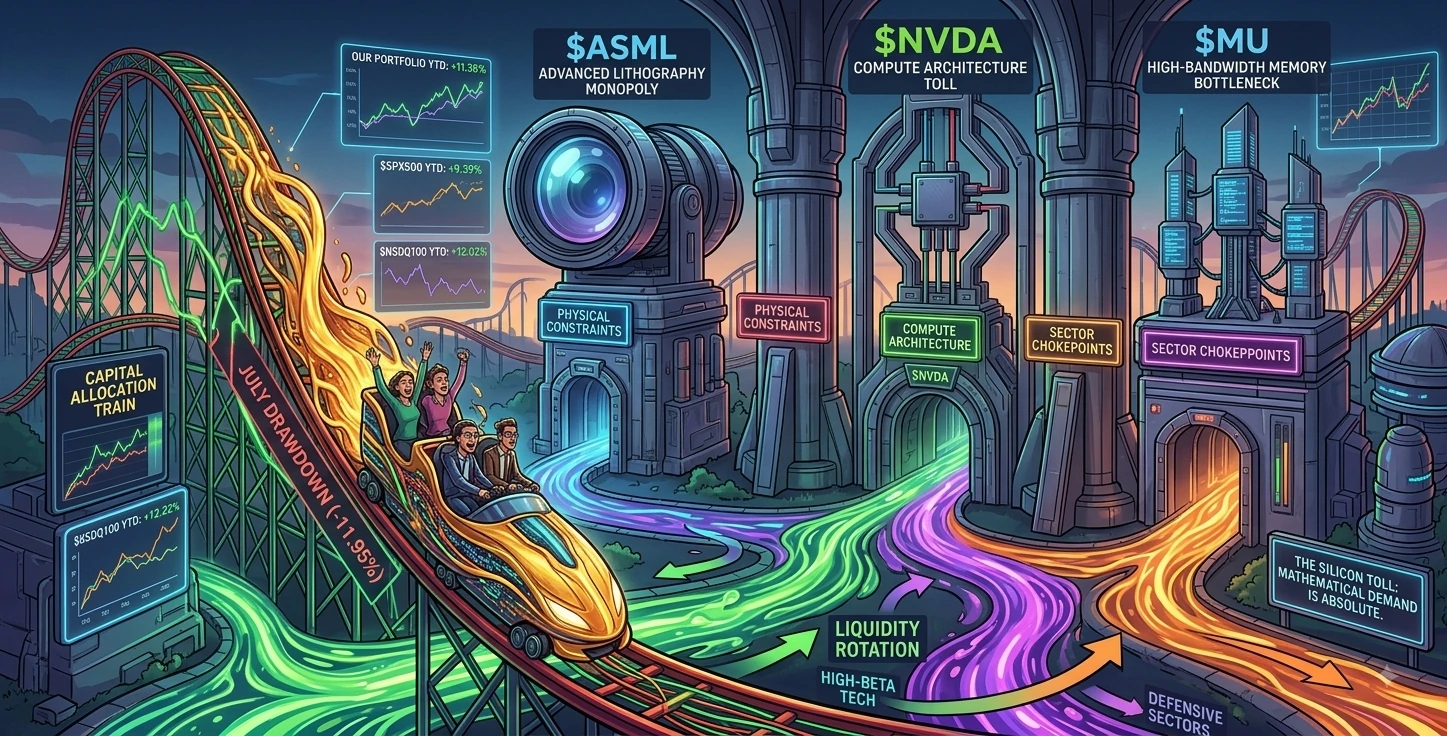
📊 𝗝𝘂𝗹𝘆 𝟮𝟬𝟮𝟲 𝗥𝗲𝘃𝗶𝗲𝘄: 𝗟𝗶𝗾𝘂𝗶𝗱𝗶𝘁𝘆 𝗥𝗼𝘁𝗮𝘁𝗶𝗼𝗻𝘀 𝗮𝗻𝗱 𝘁𝗵𝗲 𝗠𝗮𝘁𝗵𝗲𝗺𝗮𝘁𝗶𝗰𝘀 𝗼𝗳 𝗖𝗵𝗼𝗸𝗲𝗽𝗼𝗶𝗻𝘁𝘀
The July performance report is delayed as I recently returned from a family vacation in Spain. Evaluating the mechanics of the roller coasters at PortAventura provided a fitting parallel to the structural turbulence we witnessed in the markets over the past month.
July functioned as a definitive liquidity event, providing a necessary stress test for our structural monopoly thesis. Despite the short-term negative print, the underlying math dictates optimism.
𝟭. 𝗧𝗵𝗲 𝗝𝘂𝗹𝘆 𝗗𝗿𝗮𝘄𝗱𝗼𝘄𝗻: 𝗔 𝗟𝗶𝗾𝘂𝗶𝗱𝗶𝘁𝘆 𝗘𝘃𝗲𝗻𝘁
Beneath the surface-level stability of the $SPX500, the market executed a violent internal rotation. Institutional capital systematically de-risked from high-beta tech assets to reallocate into historically underperforming sectors.
• $SPX500 July: +𝟬.𝟮𝟭%
• $NSDQ100 July: -𝟱.𝟭𝟵%
• 𝗢𝘂𝗿 𝗣𝗼𝗿𝘁𝗳𝗼𝗹𝗶𝗼 𝗝𝘂𝗹𝘆: -𝟭𝟭.𝟵𝟱%
Our portfolio absorbed a concentrated drawdown precisely due to our deliberate exposure to the semiconductor supply chain. During liquidity shocks, trading algorithms do not differentiate between speculative software platforms and the physical monopolies dictating global compute infrastructure. Everything is sold proportionally to raise cash.
𝟮. 𝗧𝗵𝗲 𝗙𝘂𝗻𝗱𝗮𝗺𝗲𝗻𝘁𝗮𝗹 𝗗𝗶𝘀𝗰𝗼𝗻𝗻𝗲𝗰𝘁
We evaluate our positions against the structural demand for hardware, not short-term capital flows. The recent earnings data from major hyperscalers confirmed a continuation of the multi-trillion-dollar CAPEX arms race. They are mathematically forced to continue paying the "Silicon Toll."
The physical bottlenecks we hold—such as $ASML (ASML Holding NV) for advanced lithography, $NVDA (NVIDIA Corporation) for compute architecture, and $MU (Micron Technology, Inc.) for high-bandwidth memory—retain absolute pricing power. You cannot manufacture a logic or memory chip without this specific supply chain. A temporary reallocation of market capital does not alter the physical constraints of the digital economy.
𝟯. 𝗬𝗧𝗗 𝗣𝗲𝗿𝘀𝗽𝗲𝗰𝘁𝗶𝘃𝗲 & 𝗦𝘁𝗿𝗮𝘁𝗲𝗴𝗶𝗰 𝗔𝗹𝗶𝗴𝗻𝗺𝗲𝗻𝘁
We accept short-term volatility as the explicit price for long-term alpha. Despite the July compression, our underlying thesis remains completely intact. The 1-year rolling performance (+20.16%) and Year-to-Date (YTD) data confirm the resilience of our positioning:
• $SPX500 YTD: +𝟵.𝟯𝟵%
• $NSDQ100 YTD: +𝟭𝟮.𝟬𝟮%
• 𝗢𝘂𝗿 𝗣𝗼𝗿𝘁𝗳𝗼𝗹𝗶𝗼 𝗬𝗧𝗗: +𝟭𝟭.𝟯𝟴%
We do not over-diversify to hide from volatility, nor do we chase broad market beta. We hold the line because the fundamental demand for compute power remains absolute.
Review my complete holdings and historical performance directly on the profile.