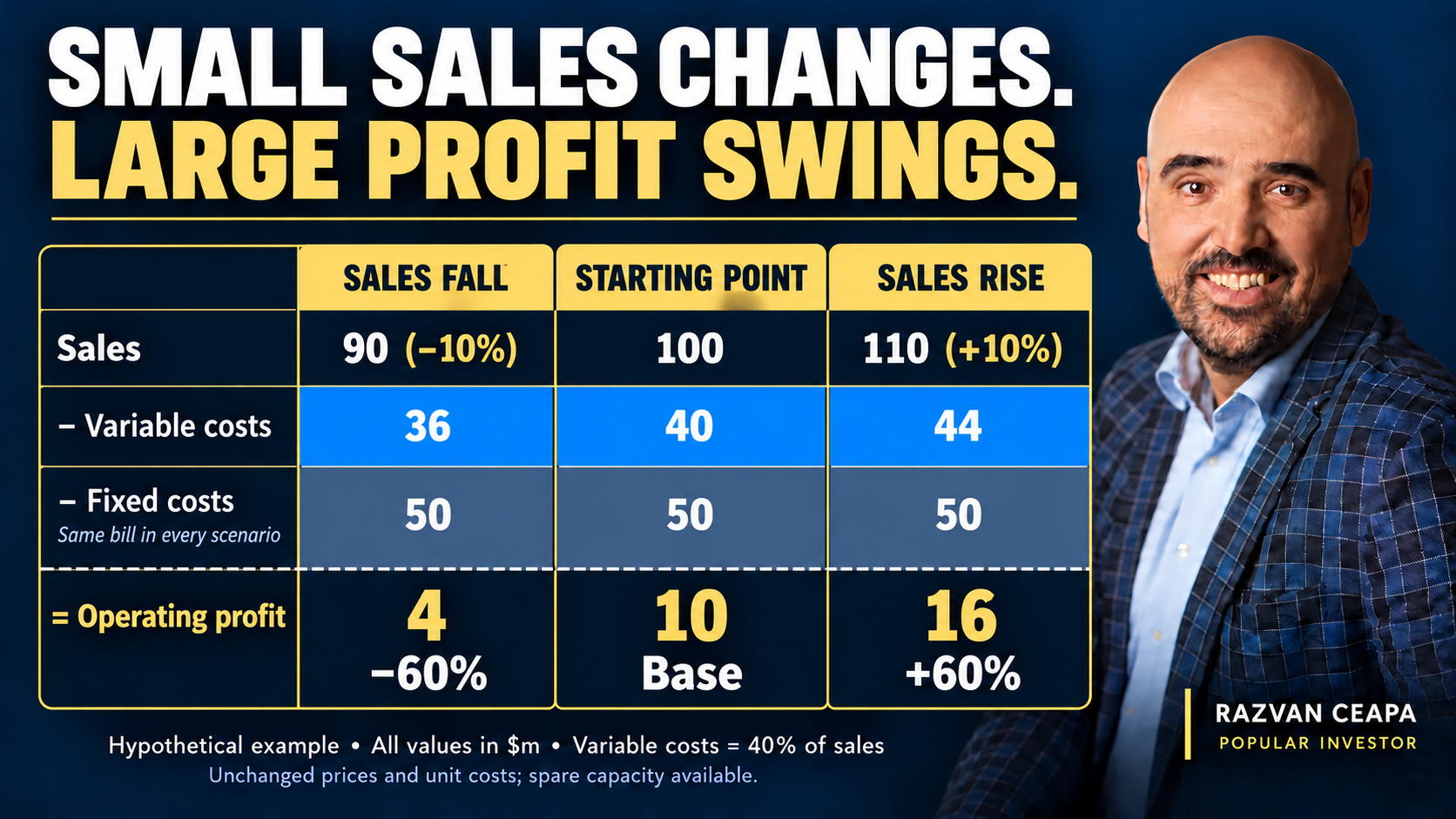
Demand and capacity determine how growth becomes profit
A fixed operating-cost base can make profit much more sensitive than revenue to changes in demand. In the hypothetical example below, a 10% movement in sales produces a 60% movement in operating profit in the same direction. We see an opportunity when durable demand fills existing capacity, but the same mechanism creates downside when demand weakens. Capacity use, the timing of expansion and the cost of serving growth determine whether higher sales produce better margins.
The same fixed bill magnifies growth and decline
Consider a business with annual fixed operating costs of 50 million dollars and variable costs equal to 40% of sales. Selling prices and variable costs per unit are unchanged, and the business has enough spare capacity to handle higher volume.
The following are alternative scenarios from the same starting point. All figures are in millions of dollars:
• Starting point: 100 revenue − 40 variable costs − 50 fixed costs = 10 operating profit.
• Sales rise 10%: 110 − 44 − 50 = 16 operating profit, an increase of 60%.
• Sales fall 10%: 90 − 36 − 50 = 4 operating profit, a decline of 60%.
Each extra dollar of revenue contributes 60 cents after variable costs. While the fixed bill stays unchanged, that amount adds to operating profit. When revenue falls, fewer sales must carry the same bill.
The difference between the percentage changes has a simple explanation. Six million dollars represents 6% of starting revenue but 60% of starting operating profit. The smaller profit base makes the earnings response look much larger than the sales movement.
This is an operating-cost effect, independent of borrowing. A debt-free business can still experience substantial swings in profit. The calculation is an illustration under stated assumptions, not a forecast for any company.
Existing capacity becomes valuable when durable demand fills it
In software, more Adobe subscribers can share the cost of product development. In streaming, the same Netflix series can reach more paying members. In TSMC chip factories and Amazon fulfilment centres, the question is how much additional volume existing facilities can serve.
None of these examples implies that serving additional customers is free. The potential benefit comes from revenue increasing faster than the cost base over a relevant range of activity.
Unused capacity also needs an explanation. A new facility may be building toward an expected level of demand, or an established operation may be underused because customers are buying less than anticipated. The first can offer room for future profit growth; the second can leave sales insufficient to cover costs.
Our analysis therefore needs evidence of customer demand and the economics of serving it. A large facility or content library does not establish an attractive return on its own.
Expansion can delay margin improvement
A cost is fixed only over a particular period and range of activity. More staff and new facilities can raise running costs before the additional capacity is fully used.
This creates a trade-off. An expansion may support the company's future growth while weighing on current margins. The assessment depends on whether demand is likely to fill the new capacity and whether the eventual economics justify the investment.
The downside deserves equal attention. If sales weaken, management may be unable to reduce costs immediately without damaging operations or future demand. The same structure that helped profit grow can then make the decline more severe.
Strong sales growth can still produce a narrower margin
Microsoft's FY2026 revenue and operating-income growth were 18% and 21%; Intelligent Cloud's were 30% and 28%. Its lower gross-margin percentage reflected AI investment and sales mix, partly offset by efficiencies. The year ended 30 June 2026.
Source: Microsoft FY2026 Annual Report
https://www.microsoft.com/investor/reports/ar26/
Intelligent Cloud's operating income increased in dollars, but grew more slowly than its revenue. An increase in profit is therefore compatible with a decline in operating margin.
The real business reflects several forces, not a controlled test of fixed costs. Pricing, the mix of services sold, efficiency and the timing of investment can all affect the result. We should not attribute a margin change to capacity use alone without evidence.
More profitable growth must be demonstrated rather than assumed
The attractive case combines durable demand with the ability to serve more customers using capacity already in place. The risk is assuming that every underused factory or newly built data centre will eventually deliver an attractive return.
Three questions organise our assessment:
• Fixed costs: Which costs stay largely unchanged when sales rise or fall, and over what period?
• Capacity use: Is existing capacity filling, or does further growth require another expansion?
• Margin change: Is the change explained by higher use, pricing, the mix of products sold or another round of spending?
These questions test both the potential benefit of growth and the business's exposure to a slowdown. We look for evidence that revenue can become sustainable profit, rather than extrapolating a strong sales growth rate into an automatic margin improvement.
For more on how we assess long-term growth businesses, visit Razvan Ceapa's eToro profile:
https://www.etoro.com/people/razvancd
Copy Trading is not investment advice | Capital at risk | Past performance does not guarantee future results