Weekly portfolio review · 19–23 October 2026
Executive summary
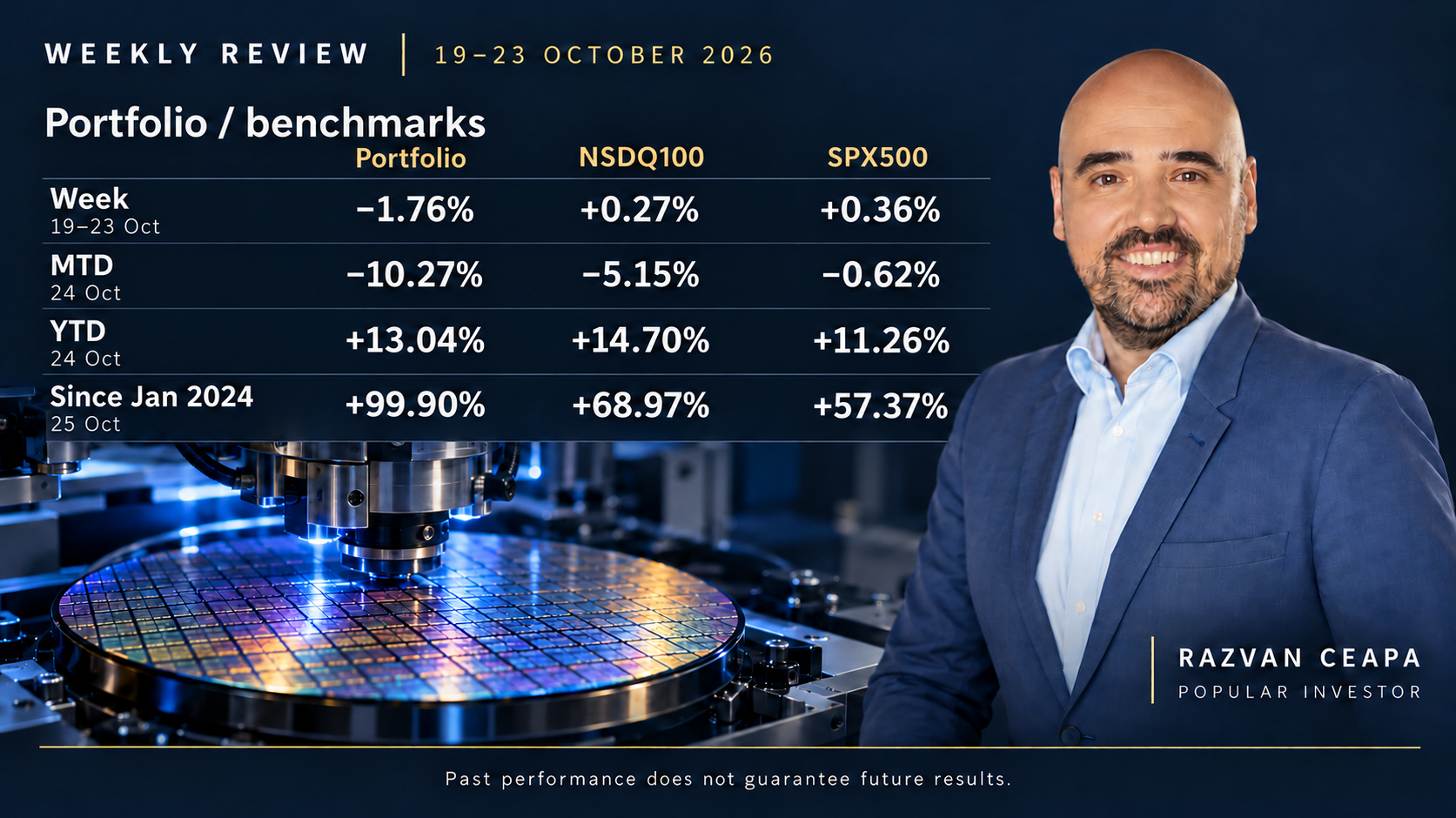
Our portfolio fell 1.76% in 19–23 October 2026, compared with gains of 0.27% for NSDQ100 and 0.36% for SPX500. The early-week rebound reversed as losses in chip-equipment holdings outweighed gains in software.
The underlying business evidence was more encouraging. Lam Research's revenue growth and NVIDIA's commitment to testing capacity support the opportunity created by AI demand. SpaceX brings further AI exposure alongside a substantial capital commitment. Moderna's clinical results strengthen a separate long-term opportunity, with approval and commercial execution still ahead.
| Period | Our portfolio | NSDQ100 | SPX500 |
|---|---|---|---|
| Month to date, to 24 October 2026 | −10.27% | −5.15% | −0.62% |
| Year to date, to 24 October 2026 | +13.04% | +14.70% | +11.26% |
| Since January 2024 | +99.90% | +68.97% | +57.37% |
The long-term view was checked on 25 October. These are distinct observation windows, not a single common closing date. We are 1.66 percentage points behind Nasdaq this year, but 30.93 points ahead since January 2024.
Equipment concentration explains most of the loss
Based on share-price changes, we estimate that ASML, KLA and Lam Research subtracted 1.31 percentage points from the portfolio. Moderna cost another 0.44 points, while Palo Alto Networks and Palantir added 0.89 points between them. These are our estimates, not official portfolio attribution.
Semiconductors and equipment represented 64.03% of portfolio value on 25 October. The companies serve different stages of the production process, but much of their demand depends on the same AI investment cycle. This shared exposure is a material portfolio risk even when the individual businesses have different technologies and customers.
AI demand creates an opportunity that delivery must fulfil
Lam Research reported quarterly revenue of USD 8.22 billion, up 22% from the previous quarter. Management's preliminary forecast puts industry chipmaking-equipment spending above USD 200 billion in 2027.
That supports the opportunity for equipment suppliers. Components and cleanroom space, the ultra-clean production areas needed to make chips, remain constraints on delivery. Supplier growth depends on turning demand into equipment that customers can install and use; shortages can shift revenue between quarters.
NVIDIA is committing USD 1.1 billion to reserve capacity with chip-testing specialist KYEC. US volume testing is targeted for April 2027. Testing checks that chips work before shipment, making it another necessary step between manufacturing output and products customers can use.
For our holdings, capacity expansion can support years of growth. The practical test is how reliably that expansion becomes delivered capacity and revenue.
SpaceX broadens the opportunity and increases the capital commitment
SpaceX reported USD 14.6 billion of third-quarter revenue. Its businesses now include AI infrastructure, Grok and coding platform Cursor alongside rockets and Starlink. This broadens its opportunities while adding to our exposure to AI spending.
Quarterly capital spending was USD 19.6 billion, mostly in AI, compared with about USD 9.6 billion of operating cash flow. Its quarter-end cash balance of USD 51.3 billion provides room to invest. Product adoption and revenue must ultimately justify the capital committed.
A possible combination with Tesla remains under evaluation, not an agreed deal. Our assessment therefore remains focused on the business and spending already reported rather than assuming a transaction will occur.
Moderna strengthens its clinical case ahead of commercialisation
Phase 3 results released on 22 October showed a 42% relative reduction in recurrence-or-death risk after surgery for stage IIB–IV melanoma. The trial compared Moderna's personalised treatment plus Keytruda with Keytruda alone. It is still too early to know whether patients live longer overall.
Approval and commercial adoption still lie ahead. Each treatment is made from an individual patient's tumour information, so reliable production at scale remains a separate challenge. The encouraging clinical evidence strengthens the long-term case even though the shares detracted from the portfolio during the week.
The coming earnings reports test both sides of AI investment
Microsoft and Alphabet report on 28 October, followed by Amazon on 29 October. We will look for cloud growth and cash generation to support their infrastructure commitments. KLA's 28 October results will add evidence on equipment demand and delivery.
These reports connect the companies buying AI capacity with those supplying it. Spending plans support the supplier opportunity; the buyers must also turn capacity into useful services and business results.
We believe AI's growing capabilities will create opportunities far beyond today's uses. We seek businesses with the technology and scarce production capabilities to serve that demand profitably. The latest results strengthen parts of that case. Execution, valuation and concentration remain the risks to weigh against it.
How to mirror this portfolio
If this long-term approach fits your risk tolerance, explore copying through Razvan Ceapa's eToro profile, razvancd. Razvan's recommended starting amount is USD 500, not a platform minimum.
Copy Trading is not investment advice | Capital at risk | Past performance does not guarantee future results