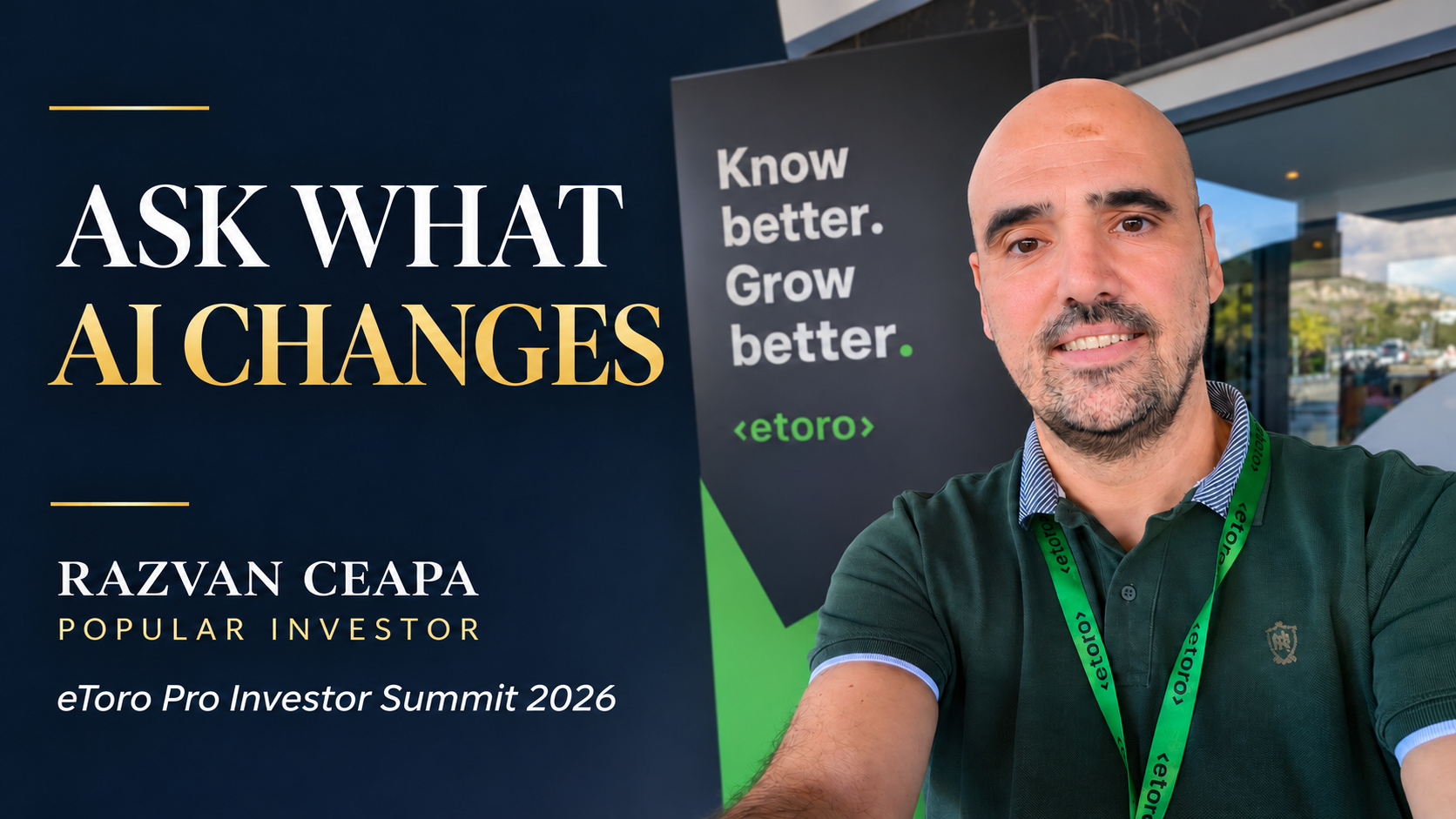
Executive summary. Our focus at the eToro Pro Investor Summit is to examine how new AI capabilities could improve investment decisions, support products customers rely on and change the contribution people make. We are starting from a conviction in AI’s long-term potential and looking for practical examples that help us test and refine that view.
The eToro Pro Investor Summit takes place in Limassol on November 3–5, 2026. It brings together investors from around the world, eToro’s leadership and speakers from AI and finance. The programme combines discussions about the future of investing with practical sessions on AI tools and risk management.
Our investment focus on AI’s “picks and shovels” reflects the importance of the infrastructure that makes new applications possible. NVIDIA’s computing systems and ASML’s chipmaking equipment are part of that foundation. The questions we are taking into the summit concern what people can do with these capabilities, how they use them in practice and where that might lead.
Test whether AI improves the investment decision
The first question is straightforward: can AI help us make a better investment decision, and how can we check the evidence behind its answer?
Microsoft and Google are bringing AI into tools for working with information. A faster summary is useful, but the more interesting test is whether a tool helps us compare competing explanations, identify a missed assumption or ask a sharper question.
We want examples where an answer can be traced to original sources and conflicting evidence remains visible. If a tool highlights something we overlooked, we still need to establish whether it is accurate, relevant and strong enough to change our view.
That keeps the purpose of the exercise clear. AI may improve the research process; judgement and responsibility for the investment decision remain ours.
Look for uses customers keep paying for
The second question concerns everyday work. Which AI uses that seemed impractical a year ago are becoming routine? Where is the benefit strong enough that customers keep paying?
For a cloud provider such as Amazon Web Services, this connects demand for computing to what customers achieve with it. We want to understand what changes in a working day: what becomes possible, where quality improves and how much time is saved after the output has been checked.
Those details help us distinguish a compelling demonstration from a product people rely on. They also give us something concrete to examine alongside delivery costs, competition and valuation.
Ask how people will add value alongside AI
The third question reaches beyond the portfolio: how do people see their role working alongside AI three years from now? What value will they bring to society? What would they tell a child starting school today?
For investors, these questions concern the businesses that could benefit from new capabilities and the work needed to put them to use. For parents, they concern how to prepare children for a world that may operate differently from the one they know.
We want practical answers about what people should learn, practise and take responsibility for. An example of a changing role can be more useful than a broad prediction about the future of work, particularly when it makes clear which decisions still require human judgement.
Bring back better questions and evidence
Better research, useful products and human contribution belong in the same conversation. Our aim in Limassol is to find examples and ideas that sharpen our thinking, including those that challenge our starting assumptions.
This is the starting agenda. What we learn should help determine which questions deserve deeper research and which ideas are worth testing in our own work.
For the broader context behind these questions, read our investment thesis and research approach. Our public eToro profile brings together portfolio positioning, performance and ongoing commentary.
Copy Trading is not investment advice | Capital at risk | Past performance does not guarantee future results