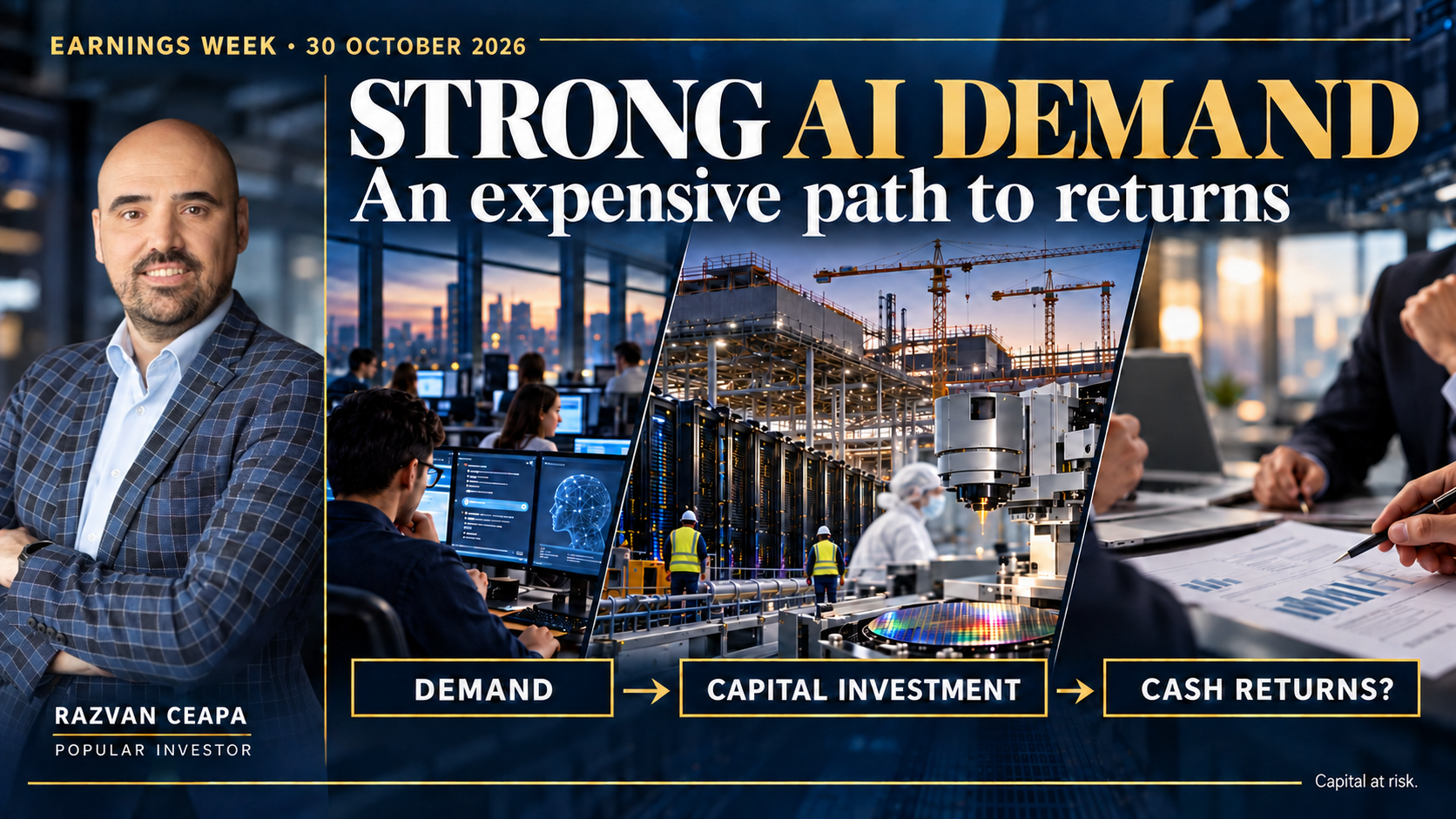
The week's earnings strengthened our confidence that demand for computing is expanding. They also sharpened the investment question: how much of that growth will become lasting cash generation for shareholders?
Microsoft, Alphabet and Amazon reported stronger cloud businesses. KLA showed how investment in computing capacity also reaches the equipment used to manufacture chips. Together, the reports describe an expanding opportunity whose eventual returns still depend on the cost of serving it.
Strong sales are becoming operating profits, but reported earnings need context
For the September quarter, Azure revenue grew 48%, Google Cloud grew 103%, and Amazon Web Services grew 39.3%. These are encouraging commercial results, rather than a clean market-share comparison. Google Cloud includes sales of TPU computing systems as well as services, and none of these growth rates represents AI revenue alone.
Operating profit also improved: Microsoft's rose 21%, Alphabet's 30%, and Amazon's increased from $17.4 billion to $28.1 billion.
Reported net income, however, carried additional effects. Microsoft's growth benefited from the comparison with OpenAI investment losses a year earlier. Alphabet's investment losses depressed earnings, while Amazon was comparing against substantial Anthropic gains in the prior year.
Those effects matter to shareholders. Separating them from operations helps us distinguish changes in customer demand from changes in the accounting value of investments.
Amazon's retail comparison also requires care. Moving Prime Day largely into the second quarter reduced reported third-quarter sales growth. That explains part of the comparison without removing the need to deliver through the holiday season.
Capacity spending is absorbing cash before its full payoff arrives
The cash-flow statements show what serving that demand costs.
Alphabet spent more on property and equipment than it generated in operating cash during the third quarter, producing a $9.1 billion quarterly free-cash-flow outflow. Its trailing twelve-month free cash flow remained positive.
Amazon reported a $42.4 billion free-cash-flow outflow over the trailing twelve months and retained its approximately $220 billion cash-investment plan for 2026. These figures cover different periods; they should not be treated as directly comparable quarterly results.
Building capacity can support future earnings. The return on that spending depends on how fully the equipment is used, the prices customers pay and how long the equipment remains economically useful. Sales growth is encouraging evidence, but it cannot answer all three questions.
Amazon's initial share-price reaction captured some of the tension. At 16:41 New York time on 29 October, the shares traded at $231.98, down 4.84% from the $243.79 regular-session close. This is a dated early after-hours snapshot, not a final market verdict or evidence that one factor alone caused the move.
KLA shows the investment cycle reaching chipmaking tools
KLA's report adds a relevant perspective for our portfolio. September-quarter revenue increased approximately 29% to $4.14 billion, with $1.34 billion of free cash flow.
Its inspection and measurement tools help chipmakers detect defects as manufacturing and packaging become more complex. Computing capacity requires working chips; producing those chips requires tools that can identify problems in increasingly demanding processes.
KLA therefore provides evidence from another part of the investment chain. It does not remove cyclicality: equipment orders and factory investments run on different timelines, while customer spending cycles and export restrictions remain risks.
Shareholder value depends on what the new capacity earns
For investors with Nasdaq-100 exposure, these reports support a more useful discussion than whether AI demand exists. We want to understand the return earned on the capital committed to meeting it.
Our long-term view remains constructive. The next evidence we want to see is capacity becoming productive, operating gains surviving competition, and more of the resulting cash reaching shareholders. Strong growth creates the opportunity; the economics of delivering it determine the reward.
Follow our positioning and research on Razvan Ceapa's eToro profile.
Copy Trading is not investment advice | Capital at risk | Past performance does not guarantee future results