Executive summary
AI is making a wider range of scientific and commercial problems practical to investigate. AlphaGenome Atlas helps researchers prioritise possible genetic changes; AlphaEvolve improves algorithms used in scientific and business models. We see the long-term opportunity in the products and services specialists can build around these capabilities. Capturing that opportunity still requires repeatable results, commercial execution and a price that leaves room for uncertainty.
Predictive maps expand the questions scientists can pursue
Testing nine billion possible DNA changes one by one in a laboratory is not practical. A useful map of where to look can change the research questions scientists are able to pursue.
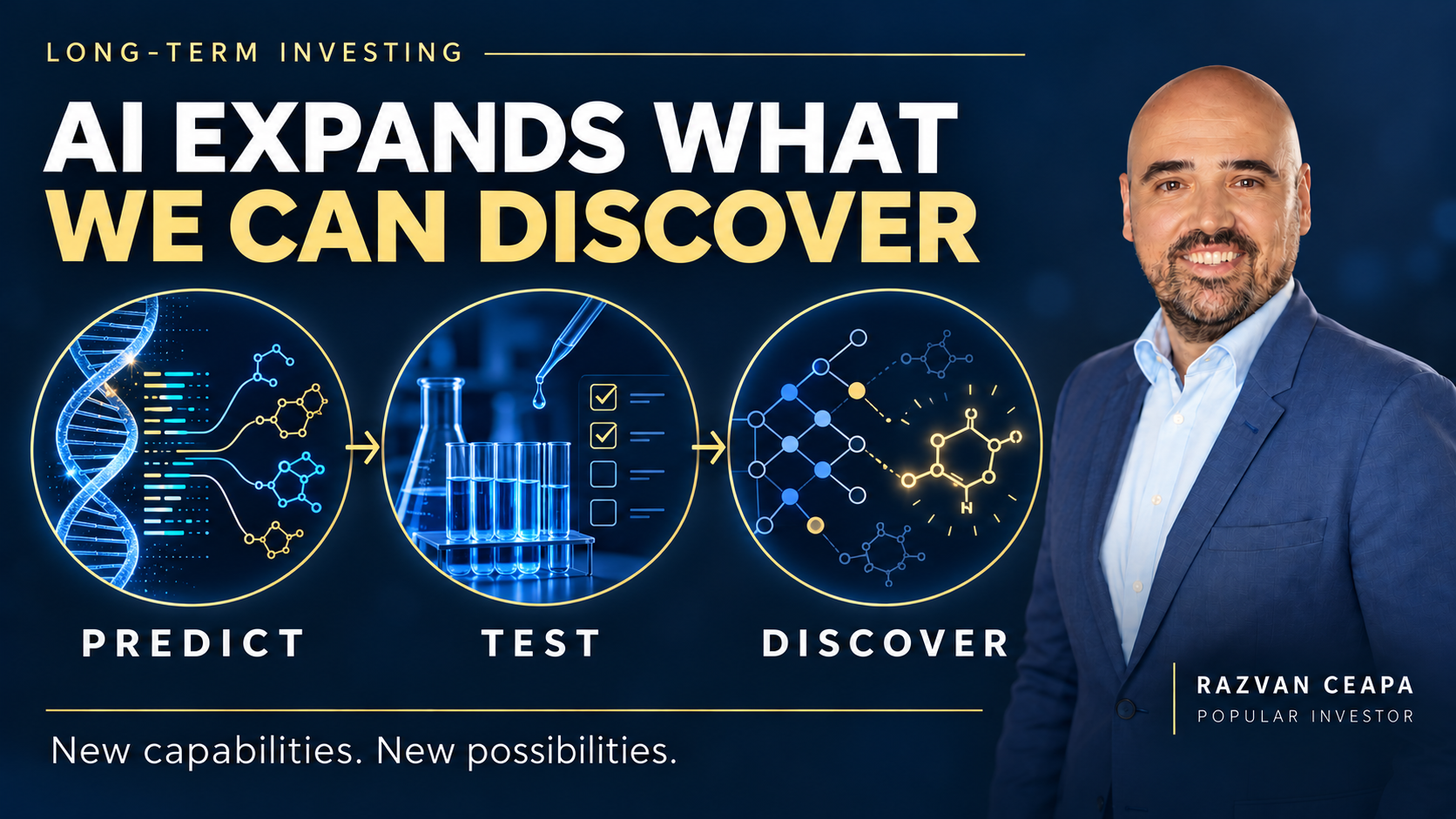
In September 2026, Google DeepMind introduced AlphaGenome Atlas, with predictions for the molecular effects of 9 billion possible single-letter changes in the human genome. Researchers can use that map to rank variants and decide which deserve closer investigation before committing scarce laboratory time to selected experiments.
In one rare-disease study, the tool helped researchers identify an overlooked genetic change whose predicted effect was then supported by laboratory experiments. The sequence is significant: a prediction guided an investigation, and physical testing supplied further evidence. AlphaGenome has not been validated or approved for clinical use.
The economic mechanism is a wider search followed by selective testing. More possibilities become practical to examine without assuming that a computational model can replace all scientific validation.
Better algorithms can expand the work a research budget supports
AlphaEvolve takes a different approach. It proposes algorithms, runs them through automated tests and uses the results to develop better versions. People still have to define useful problems and reliable tests.
At PacBio, AlphaEvolve helped improve the model that turns sequencing signals into DNA reads. More accurate input data helps researchers distinguish genuine genetic changes from measurement errors.
For Schrödinger, Google Cloud’s June 2026 case study reported that AlphaEvolve delivered a roughly fourfold speedup in training and running the molecular models studied. These models estimate forces between atoms to simulate molecular behaviour.
Faster computation can support exploration of a larger range of molecules within a research budget. A team may investigate candidates it previously could not afford to examine. The same capability has applications in drug research, catalysts and materials design.
The reported speedup applies to the molecular models studied, not to the entire process of developing an approved medicine. Candidate medicines and materials still need laboratory validation. What improves is the range of ideas researchers can seriously explore.
Specialist applications can turn technical progress into businesses
The search for better methods also travels beyond laboratories. Klarna reported doubling training speed, with better predictions, in an AlphaEvolve project involving one of its payment-data models. WPP used it to improve models that predict marketing-campaign performance and suggest campaign choices.
These examples show a common technical approach being applied to different kinds of work. Each industry brings its own expertise, customers and standards for a useful result. A successful project does not by itself establish a profitable product or prove that the company using the technology will capture all the benefits.
The commercial connection we look for is the ability to build on the result. More reliable research tools can support scientific services; better predictive models can become features in specialist software. Companies need the expertise and customer relationships to develop those applications into products people value.
This broadens the opportunity beyond savings on existing work. A capability becomes reliable, specialists find useful applications, and businesses build products around them. The resulting opportunities may extend beyond the spending categories visible today.
Long-term conviction depends on repeatable progress
Our investment research focuses on three questions:
• Identify the new capability. What can people now do that was previously impractical?
• Check repeatability. Does it work beyond a selected demonstration?
• Follow the path to a product. Does the company have the expertise and customer relationships to develop it?
These questions help distinguish an expanding opportunity from an impressive announcement. Technical progress can still disappoint commercially. Competitors can capture the benefits. A share price can already assume more success than the company ultimately delivers.
Our conviction comes from the growing range of problems AI can help solve. A long horizon gives those possibilities time to develop. The evidence determines which businesses deserve our capital, and valuation remains part of that judgement.
If this approach fits your risk tolerance, review our portfolio and results before deciding whether copying suits you:
https://www.etoro.com/people/razvancd
Copy Trading is not investment advice | Capital at risk | Past performance does not guarantee future results
Primary sources
AlphaGenome Atlas: https://deepmind.google/blog/alphagenome-atlas-a-predictive-map-of-every-possible-dna-letter-change-in-the-human-genome/
AlphaEvolve: https://deepmind.google/blog/alphaevolve-impact/
Schrödinger: https://cloud.google.com/blog/products/ai-machine-learning/schrodinger-alphaevolve-molecular-discovery-accelerates-4x
WPP: https://www.wpp.com/en/news/ai-research-as-the-next-creative-frontier