Executive summary
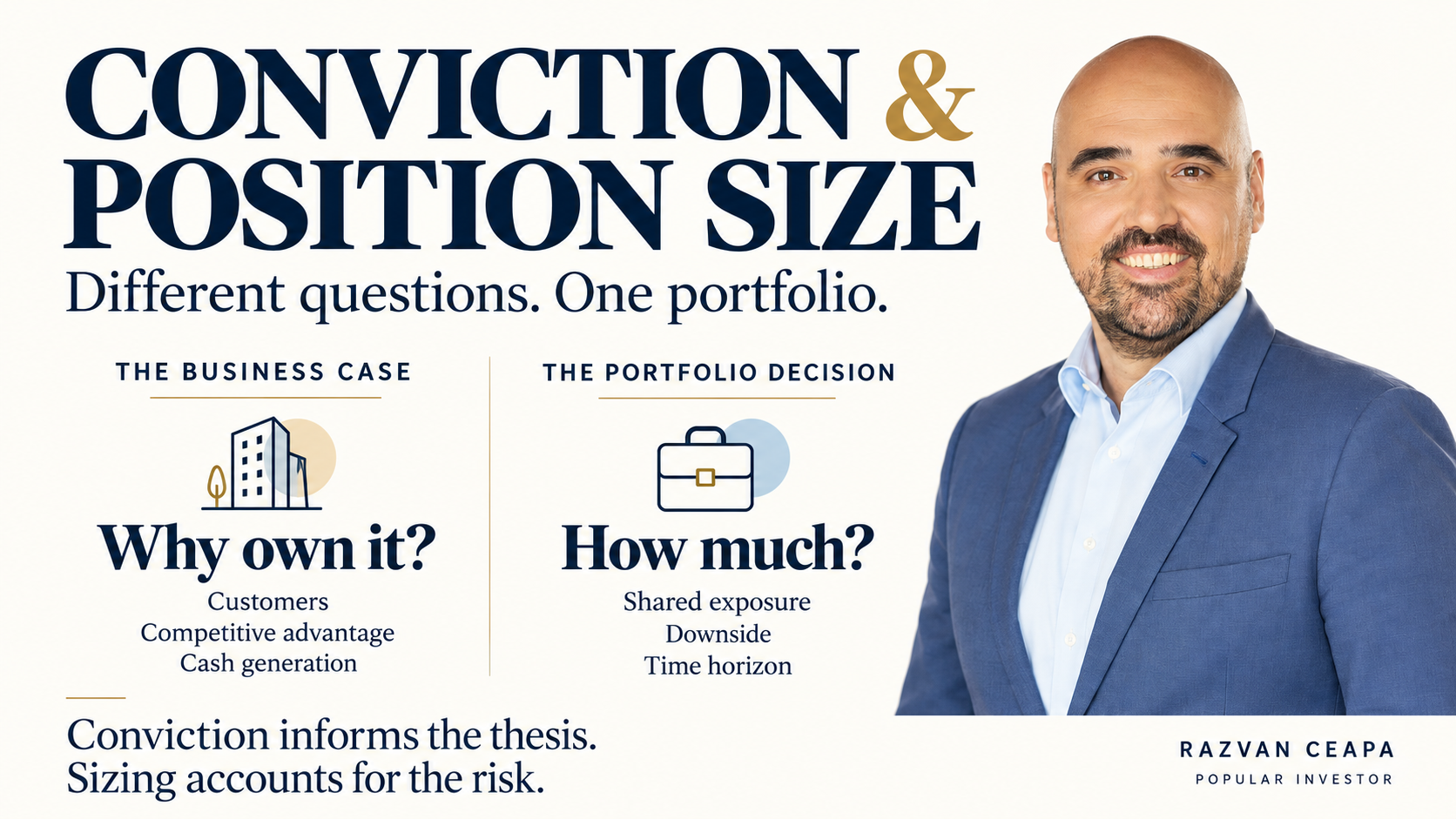
Conviction explains why we might want to own a business. Position size determines how much of the portfolio can depend on that investment case being right. We can understand a company well and expect it to become more valuable while still limiting its weight because of valuation, uncertainty, shared exposures, cash needs or the alternatives available.
The trade-off runs both ways. A smaller position reduces the damage from being wrong, but also reduces the contribution from being right. The task is to explain the allocation as carefully as the business thesis, rather than treating confidence as a sufficient sizing rule.
Business quality does not remove investment uncertainty
A convincing investment case explains why customers will keep buying, what protects margins and how growth becomes cash. Those are reasons to study a business closely. They do not, by themselves, determine its appropriate portfolio weight.
Competitive advantages can support future profits without protecting today's share price. If the valuation already assumes years of strong growth, even good operating results may disappoint investors. The quality of the company and the expectations built into its price both matter.
We also need to distinguish confidence in the direction from confidence in the range of possible outcomes. A growth opportunity may be convincing while its timing, required investment and eventual margins remain uncertain. A precise forecast does not make those uncertainties disappear.
Position sizing therefore has to consider outcomes outside the central forecast. A delayed order and a permanently damaged business can both hurt the share price, but they have very different implications for the capital at risk.
Translate a stock-price decline into portfolio consequences
Consider a hypothetical $100,000 portfolio invested without borrowing. One stock falls 40%, while all other holdings remain unchanged.
• At a 10% starting weight, the position is worth $10,000 and loses $4,000. The portfolio loss is 4%.
• At a 20% starting weight, the position is worth $20,000 and loses $8,000. The portfolio loss is 8%.
The stock-price decline is identical, but the portfolio damage doubles. Neither starting weight is a recommended allocation. This illustration assumes no trades, cash flows, fees, taxes or currency effects.
The arithmetic connects the company-level question to the portfolio decision: how much capital depends on that particular investment case?
Assess the next dollar alongside the rest of the portfolio
A holding cannot be assessed in isolation. Adding to a company may deepen exposure to a customer budget, financing condition or spending cycle already represented elsewhere. Different company names do not necessarily create different economic risks.
The investor's ability to wait adds another constraint. A thesis that needs years to develop may conflict with a near-term need for cash. Being able to sell a listed share quickly does not mean being able to sell it at an acceptable price. Less liquid investments impose a further constraint.
Capital also has alternatives. An attractive company may still be a less attractive use of the next dollar than another investment with different risks. Cash preserves flexibility, but that flexibility carries an opportunity cost if markets rise, and inflation can erode its purchasing power.
These comparisons can change without the underlying business becoming worse. The case for owning a company and the case for committing more capital to it therefore need separate explanations.
Account for the cost of being too cautious
Smaller is not automatically better. Reducing a position limits the damage from being wrong, but also limits its contribution if the investment succeeds. Spreading capital too thinly can dilute the benefit of good research. No universal percentage resolves this trade-off.
Our useful distinction is between defending a business thesis and defending its place in a portfolio. Both require reasoning. Confidence is part of that reasoning, but it cannot answer the allocation question on its own.
Review the approach before deciding to copy
If this way of examining investments resonates, review the holdings, results and risks on Razvan Ceapa's eToro profile, razvancd, before deciding whether copying suits your circumstances.
https://www.etoro.com/people/razvancd
Copy Trading is not investment advice | Capital at risk | Past performance does not guarantee future results